Photo Day: Arles and Pont du Gard

Arles and Pont du Gard (the latter you may recognize, the first perhaps not) are both in the south of France, but enough off the beaten path that we, as American tourists, don’t always have the time to see them. Understandable, with the limited vacation time we get! When people ask me for advice on where to go in France, I usually ask them what they are interested in. Seeing the sites you are “supposed” to see? Nothing wrong with that. There’s a reason places like the Louvre, the Eiffel Tower, St. Tropez, and Nice are so famous. When time is limited, I hate to miss those major attractions. What if you never get back to Paris, and you didn’t grab your chance that one day to see the Eiffel Tower or the Mona Lisa? But when people want to get away from the throngs of tourists, get a more “authentic” experience, I have tons of suggestions there, too. Arles is perhaps in the middle. It’s still a tourist destination, but less crowded than many others.

Arles

Arles

Entering the midieval portion of Arles

Entering the midieval portion of Arles

Here’s one of Arles’ main claims to fame: It’s where Van Gogh painted Cafe Park By Night:

453 Place where Van Gogh painted Cafe Park by night

While we were in Arles, we attended a bull fight. It wasn’t the fight to the death kind, I couldn’t stomach that. In this type of fight, the bull has a thick collection of yarn laced around his horns. A team of players tries to distract the bull, while one of them uses a special tool – a rigid (and aggressive looking) extension of his hand – to tear at the yarn. If all the yarn is torn before the timer goes off, the players win. Otherwise, the bull wins. The bull always lives to be tormented another day. The players display an impressive array of acrobatic skills as they run, dodge, then leap from the bull pen to cling for their lives to the surrounding barriers.

458 Look out!

461 Run!

Just on time!

Just on time!

467 going for the yarn

469 Mad bull

477 Yikes!

Awards Ceremony

Awards Ceremony

Here are some photos of Pont du Gard, a well preserved aqueduct from ancient Roman times:

498 Pont du Gard

The Rhone at the Pont du Gard

The Rhone at the Pont du Gard

502 Pont du Gard

Inside the Aqueduct - we were able to walk through from one side to the other

Inside the aqueduct – we were able to walk through from one side to the other

Masculine vs. Feminine

DSC01570 I started learning French when I was 29 years old. In my day, foreign language education began in high school and we only had to take two years. In college, my major (microbiology) had no foreign language requirement.

Funny story: I really wanted to take French in high school, but my mom said to me: “You’ll never have any occasion in your life to use French. We live in Arizona. You need to take Spanish.” So I did. Then I married a Frenchman. I love to remind her of this whole event sequence.

After finishing grad school, I met a few French people, fell in love with the language, and decided to take night classes at a small conversation-oriented school to learn how to say “Bonjour” and “Paris” so it would rhyme with “Whee!” A couple immersion programs in France, some private lessons, and a French husband later, and my French is, overall, decent.

Because my “formal” education in French has been minimal, I have holes in my knowledge. Sometimes they are big and gaping, like the issues I have with masculine vs. feminine. Already a difficult concept for the Anglophone, I spent a lot of years whatever-ing the whole thing until I had to admit it actually does matter.

I can’t be the only one who struggles with this in French. Why oh why can’t it be easy, obvious, like it is in Spanish?

Here are a few references I’ve found helpful:

http://french.about.com/od/grammar/a/genderpatterns.htm

http://www.pimsleurapproach.com/resources/french/grammar-guides/masculine-feminine/

http://www.french-linguistics.co.uk/grammar/le_or_la_in_french.shtml

I love my Visual French-English dictionary, too. It's fun to thumb through, and I do learn from it!

I love my Visual French-English dictionary, too. It’s fun to thumb through, and I do learn from it!

The best/worst advice I’ve (often) received: You just have to learn as you go.

Because there are so many rules and exceptions to rules, learning as you go, from the beginning, is the best route.

I tried to do note cards the other day, based on some of the patterns listed in the websites above. That lasted about 5 minutes before I threw all the note cards I’d worked so hard to create into the recycle bin. Does anyone ever really learn that way? For something other than a cram session for an exam where all the info will be forgotten in a week or two? I’m a complete grammar nerd, but I still recognize a futile attempt when I see it.

Part of my research into bilingualism and teaching languages has shown that our understanding of how best to acquire new languages has evolved greatly, and continues to evolve. It’s much more of an organic process than our typical teaching methods (i.e. rote memorization and recitation) allow for.

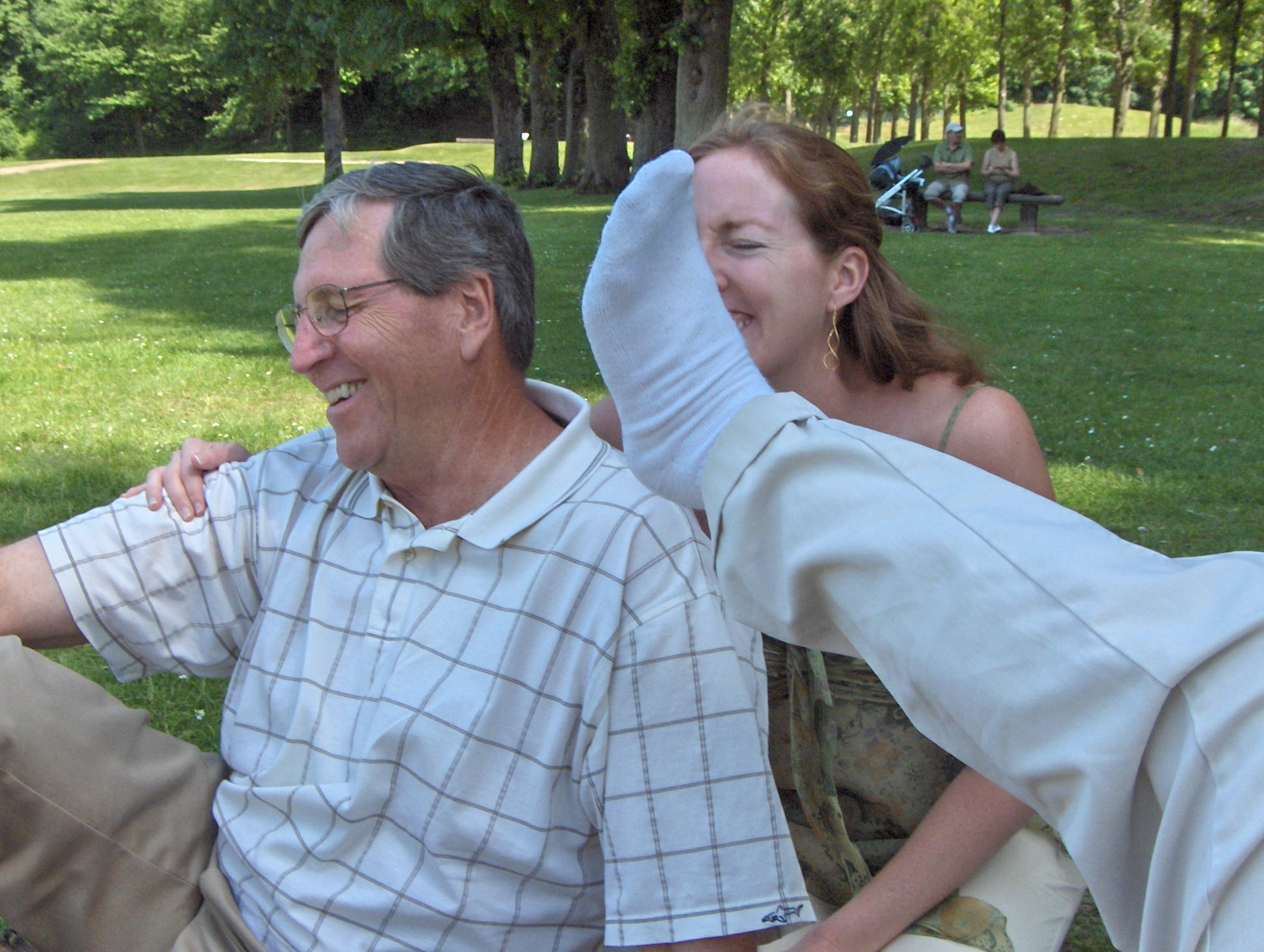
I'd rather have my brother stick his foot in my face while I'm posing for a sweet picture with my dad in France than study from notecards.

I’d rather have my brother stick his foot in my face while I’m posing for a sweet picture with my dad in France than study from notecards.

I need to build associations and habits, not stare at cards. I need to think and speak in French when I go to the grocery store so that I know it’s “la” banane and “le” brocoli. I need to look around my house, think about, talk about the objects I use every day. Le livre. La cuillère. Le four. La table. And so on.

I just want a simple rule or two to follow, but that’s not how French works. It’s going to be a long process before this whole gender thing comes naturally, and accurately, for me.

Yet here are couple that have stuck in my brain for years: problème is masculine and solution is feminine. Hmmm.


BIENVENUE 2014 ! And Ten French Goals for the New Year.

DSC01537

I’m so ready for this change. New Year’s Eve, my husband and I enjoyed our yearly tradition of making a meal together, reminiscing the past year, setting goals and making plans for the year to come. I love this tradition of ours: the good food, the good company, and the way I wake up January 1 feeling recharged and ready for the great things we have planned. Often I find myself nostalgic as I watch the clock tick toward midnight on December 31; sometimes even sad to bid adieu to the year that has gone. This year, none of that – 2013 was a mixed bag for me, and I’m happy to move on. New year, fresh start, clean slate… bring it. (Do people still say that?)

Les Moules (Mussels)

Les Moules (Mussels)

Bon Appetit !

Bon Appetit ! Moules-frites: our New Year’s Eve feast.

This year, we set new personal goals and made some travel plans – smaller scale than some years past, but we have some great trips to look forward to.

Here on my blog, I’m posting my language/blogging goals:

1. Volunteer at my daughter’s school by offering a French lesson each week.
I’m scaring myself with this one. Talking in a foreign language to a bunch of 2, 3, and 4 year olds? How will I keep their attention? How do I go about making a lesson that’s captivating to preschoolers, let alone in a language none of them speak (yet)? Still, I have several ideas that I’m excited about and I’m feeling up to the challenge. I’ve discussed it with the head of the preschool, and now I’ve written about it on my blog. So, I’m officially committed. Holy… merde.

2. Read five books in French.
I’ve got a few picked out already. It’s always hard to begin a French book for me – reading is normally such a pleasure, yet reading in French is work. I remind myself that once I get into a book, I forget that I’m reading in French and I start to enjoy it rather than slug through it with my dictionary on constant alert.

3. Look into pursuing a Master’s in French.
University of Colorado at Boulder has a great program, as does Colorado State in nearby Fort Collins. While in San Diego, I took a few upper division French courses at SDSU and had a fabulous time. I’m toying with the idea of pursuing a master’s. Would it be simply fulfilling a personal goal of being completely bilingual, or could this be a career change – I don’t yet know. What I do know is that I love learning French and that improving my French benefits my entire family. I’m not quite ready to return to work full time as my kids are still so small. I have the luxury of choosing to stay home with them, yet I want/need something apart from being a mom. So, why not another degree? I can hear my friends now: Or you could chill out and address your overachiever issues.

4. Blog Entries 1-2X/weekly
Yes, continuing with my blog, posting about raising bilingual kiddos, what it’s like to be a bilingual family, and Franco-American cultural clashes is definitely on my list.

5. Continue my involvement with the multilingual blogging community.
I’ve plugged in to a great group of bloggers, all of whom are raising children in bi- or multicultural/lingual families. Several of their blogs are listed on my sidebar. Whenever I need inspiration, I just visit their blogs or our groups on Facebook.

6. French lessons for my kids twice weekly (at least).
Among the problems that many multilingual families face are: kids becoming passively bilingual – they understand the second language but don’t speak it (this seems to be developing in my home), or they speak it but reading and writing skills go undeveloped. My goal is for my kids to be fluent in speaking, understanding, reading, and writing both English and French. Whether it’s me or I hire a tutor, my kiddos need more exposure to all aspects of the French language.

7. Speak in French during two dinners/week with our family.
Currently, when we are all together, my husband speaks French to the kids but English with me. Again, the kids (and I) need more French.

8. Take advantage of the French activities in the area and try to connect with other French speakers.
I’ve found storytimes, playgroups, and group lessons so far. We’re going to participate in as much as we can.

9. French language summer school for the kids.
There are opportunities both here in the Boulder area and in San Diego for French language summer camps. Since we aren’t going to France this year, we can take advantage of local summer camps, as well as combine an extended vacation in our old stomping grounds – San Diego – with summer camps for the kids at the French American School. The beach, good Mexican food, old friends, and French? Yes, please.

10. Eat more crêpes at La Crêperie of Ft. Collins.
Because they really are good enough to merit a New Year’s Resolution.

Bonne Année !

Bonne Année !

Photo Day: Christmas in the Alps

I haven’t been to France in over two years (a toddler and a preschooler on a plane… I wish I were so brave), so many of my photos are older. These are from a Christmas we spent in the French Alps, in a small mountain village called Samoens. A beautiful, charming place, where we stayed in a cozy converted farmhouse, read books (the house had quite an Asterix collection), and indulged in Raclette after days spent on the slopes. It was my first Christmas away from my own family, so I learned of some of the French traditions my husband grew up with. Midnight mass (3 hours! We Presbyterians shudder at the thought), bûche de noel (yule log), and real chestnuts roasting on an open fire served in the village at their Christmas carnival – it was charming and so different from my own traditions. It was here, too, that I first saw Le Père Noel est une Ordure. I sat there, perplexed and not understanding, while my husband, his brothers, and my sister-in-law rocked with laughter and called out lines before the characters. Now that my French is better, as is my understanding of French humor, I find it pretty hilarious, too.

Here’s the charming farmhouse we stayed in, taken before the snow came:

035 Le Ferme

137 Le Ferme

Some photos of Samoens:

025 Fountain in Samoens

026 Samoens

139 Samoens

Twelfth century church where we attended mass . We sang Angels We Have Heard on High, one of my favorites, in French:

141 Samoens

The Alps, near Samoens:

045 Alps

075 Alps

055 Alps

060 Alps

070 Alps

Early morning frost:032 Frost

A visit to the nearby village of Annecy, with me obviously American in my running shoes:

091 Annecy

093 Annecy

097 Annecy

100 La Roche sur Foron

La Roche sur Foron

098 Annecy

And skiing in Alvoriaz:

130 Carol

135 Alvoriaz

Interview with Patrice LeJeune, Marquetry Artist

Patrice2Patrice LeJeune is a Marquetry Artist working out of Antique Refinishers in San Diego, CA, where they also run the American School of French Marquetry. I’m lucky to be friends with Patrice; aside from being a very talented artist, he’s also easily one of the funniest people I know. With his wicked, dry humor and ability to do voices and impressions, he’s a fantastic guest at any dinner party, a fun partner in Belotte, and a guy you don’t want to mess with in poker.

The term “marquetry” is from middle French, meaning “inlaid work.” It is the art of assembling veneer pieces (usually wood, but sometimes other materials like ivory, pearl, or even metal) together to make a design or picture. The techniques began in 16th century Florence as well as 16th century France. In the mid-seventeen century, French furniture makers began using marquetry techniques to provide the ornate furniture that would decorate Versailles and Louis XIV’s other royal residences.

Patrice notes that he is, “working on developing new techniques that I did not create but for which I am putting different aspects theories in place.” Wikipedia expands on Patrice’s new techniques, you can read about them here.

Circle of Life - Fusion Marquetry

Circle of Life – Fusion Marquetry

Here is my interview with Patrice:

What interested you/attracted you to the field of Marquetry?

My father was a harpsichord maker; I grew up with the smell of wood. I chose to study furniture making in order to work in the family workshop and entered Ecole Boulle in Paris at the age of 15 for a 5 year program. Unconsciously, I am sure choosing this profession at that age was to try to get closer to my father, but soon my thoughts and desires switched from musical instrument making to furniture.

In my 4th year in school we visited and studied for a couple weeks in other workshops. One of those workshops was marquetry. I really fell in love with that art and always wanted to add this skill to my toolbox.

Patrice at work

Patrice at work

What kind of school did you go to and what was your education like?

I did go to Ecole Boulle. It is an Arts and Crafts School focusing on Decorative Arts. It hosted at that time 11 workshops such as cabinet making, upholstery, turning, marquetry etc., all related to the different fields of decorative arts. The 3 first years are dedicated to traditional furniture and how to make them by hand and machine. Then 2 more years to learn how to create furniture, and to produce a master piece on a theme, “artists house,” during the last year. {It was} a piece of furniture which could be included in a house where an artist lived open to the public or a museum. I chose the Horta House in Brussels and realized a piece mixing Art Deco and nouveau.

The program included all the regular classes you have to follow in high school, with a slightly lighter program, French, another language, mathematic, science, etc. Plus an artistic side, drawing, composition, modeling etc. Plus the technical aspects, technology, machine shop, workshop, and for me, cabinet making.

What are your favorite projects to create/work on? Any favorite completed projects?

I like to work on anything that includes marquetry but mainly a job which offers challenge. My favorite project is usually the last one but there is a difference in my heart between what I do for a living, the traditional stuff, and my modern art work. Both of them are very important but I wish I had more time to work on my art.

What is a typical day like on your job?

Morning starts with breakfast in front of the computer, doing emails. Then strong coffee and chasing money. Our main business at which I spend more than half of my time is restoration. I repair and restore furniture, with a specialty on veneer and marquetry restoration, but I am also a French polisher and a gilder. When I am done chasing money, then comes the IT choir: marketing, graphic design, website design, etc. Then if I have time left, I can work on our spec marquetry projects; for now I try to find as much time to work on that.

One of Patrice's projects

One of Patrice’s projects

From this original I redesign a better quality marquetry just using the overall composition as a guide.

If I have time or a deadline or spare energy then I work on my art…

Tell me about the school at your studio.

American School of French Marquetry in San Diego, CA

American School of French Marquetry in San Diego, CA

In our school, the American School of French Marquetry, we teach French style marquetry, which for us is the best and most efficient and with the possibility of a better quality result, methods and techniques.

Our students range from amateur, hobbyist, or curious to serious professional. We have people coming from all over the world (though not Europe), but our main source of students is in the US and Canada.

Our programs are designed by weeks, each week students learn a new technique or refine their techniques. Most of the students take 2 to 3 weeks in one or two trips.

What brought you to San Diego?

Agnes (Patrice’s wife, who just completed her PhD) had a exchange program in Scotland in 2002. We loved living abroad so we looked for a good place to carry on speaking and learning English. Nothing came out of scotland or UK so We turned to the US. I did not choose San Diego, I was looking for a job and contacted Patrick Edwards who had come 4 years in a row for 3 months to my school in Paris to learn marquetry. I asked him if he knew anyone in San Francisco and he offered me a job. Not a bad decision overall.


If you are in the San Diego area, be sure to visit Antique Refinishers in their North Park workshop, or sign up to take a class or two at their school and discover your inner artist!

Here’s a link to Patrice’s blog, and some videos to learn more.

Here are some photos of Patrice’s work:

This one took Best of Show at the Design in Wood Show 2010

This one took Best of Show at the Design in Wood Show 2010

Patrice9

Replication of a piece

Replication of a piece

The finished piece

The finished piece

Patrice7

Photo Day: Les Villages Perchés en Provence (Part II)

Part II of those charming perched villages:

Tourette-sur-Loup

Tourette-sur-Loup

St. Paul de Vence

St. Paul de Vence

Moi, in St. Paul de Vence, 2008

Moi, in St. Paul de Vence, 2008

St. Paul de Vence

St. Paul de Vence

Bougainvillea

Bougainvillea

St. Paul de Vence - this place is made for photos

St. Paul de Vence – this place is made for photos

Newer part of St. Paul de Vence

Newer part of St. Paul de Vence

Passport to Paris: A touch of France in Denver, Colorado

Denver Art Museum

Denver Art Museum

Last weekend we visited the Denver Art Museum’s Passport to Paris exhibit, advertised as “More Monet in Denver than ever before.” I love the French Impressionists, so there was no doubt we were going to go, even if it meant dragging a three-year-old and an eighteen-month-old through an art museum. Between pushing buttons on the audio tours for the kids to keep them entertained (“Mommy! She stopped talking again!”) and pulling my daughter’s curious fingers away from priceless works of art (“NOOOOOOOOOO! Off limits! Eyes only!” Cue hyperventilating  Mom all too aware of angry glares from other patrons) we managed to see most of the works displayed in the show’s trio of rooms.

DSC01306

The rooms: Court to Cafe, Nature as Muse, and Drawing Room, focus on French art from the late 1600s to the early 1900s and include a fascinating look at how art and society mirrored each other through these dynamically evolving centuries. The show incorporates 50 masterpieces from the Wadsworth Atheneum in Hartford, Connecticut, 36 landscapes from the impressionist artists from the private collection of Frederic C. Hamilton – on public display for the first time, as well as drawings on paper from master artists of the period. Here are a couple of my favorites (no photography was allowed, so I had to scan them from postcards I bought):

Claude Monet Painting in His Garden at Argenteuil, 1873 by Pierre-Auguste Renoir

Claude Monet Painting in His Garden at Argenteuil, 1873 by Pierre-Auguste Renoir

The Beach at Trouville, 1870 by Claude Monet

The Beach at Trouville, 1870 by Claude Monet

If you are in the Denver area and interested, the show is here through February 9, 2014, and tickets can be purchased online or at the museum. Click here for more details.

What is Assimilation, Anyway?

I often meet people, my age or older, whose parents immigrated to the U.S. and intentionally avoided teaching their offspring their native language, believing that it would both inhibit their child’s ability to learn English and interfere with their assimilation into American culture. Every one of these now grown “children” expresses regret that they didn’t learn their family’s native tongue.

How times have changed. We now understand that, especially for young children, learning two or more languages is not only possible, but developmentally advantageous. Immigration laws have changed. Our world, too, is smaller. Once upon a time, people boarded a ship knowing they would never see their home country again. They were forced to cut all ties and make a home in the place they landed. Now, we are a Facebook or FaceTime exchange away; we can hop on a plane and be almost anywhere in the world in less than 24 hours, and we can easily find others like us wherever we are: just Google a meet-up group for whatever suits you.

We don’t have a standard definition for what “First” or “Second-generation American” means. Is the first generation the one that did the immigrating? Or the first generation born in the U.S.? As for the term “assimilation,” multiple studies aim to determine how immigrants are assimilating but struggle over how to define what assimilation actually means. Do we measure it by learning English (or the native language of whatever country is being examined)? By civic participation – becoming a citizen, becoming involved in some way? By cultural participation? Did your kids dress up for Halloween? Did you stuff yourself with turkey and mashed potatoes on Thanksgiving, then cheer on your football team while indulging in pumpkin pie smothered in whip cream from a can? Some studies look at economic achievement: jobs, home ownership. Others attempt to examine patriotism. Even more difficult to define: do immigrants feel American? And what does that mean, when even the idea of the “typical” American can vary so much, depending upon what region of the U.S. we are considering? What exactly is the essence of Americanism? Or being French?

Most bicultural or non-American families I know raising children today diligently work to make sure their children know their native cultures and native languages. They fear their children will grow up unable to communicate with family back home, or unfamiliar with what to our friends is so familiar. They embrace many of the traditions and culture of their chosen American home, yet they actively retain their own cultures as well. For us, in our French-American home, the blend is mostly easy. We both already celebrated Easter and Christmas. For my husband, Halloween and Thanksgiving are fun new holidays (though no self-respecting Frenchman would ever stuff himself silly. As for American football… he’s making valiant efforts at appreciating the sport). I had no issue with long meals full of visiting and drinking wine more often. We were both happy to have an extra holiday in July for fireworks and barbeques. Sometimes I think we should move to France just so we can enjoy May, where public holidays mean a month of, well, joie de vivre, and August, where the whole country goes South for vacation.

The challenge for most of us remains teaching our children the second, non-English language. In San Diego, multicultural families surrounded us. One time at the playground, I counted seven different languages being spoken. Seven. We were the norm there – multilingual, multicultural. Here, in Colorado, I rarely hear a foreign language. And for the first time, I feel self-conscious when I speak to my kids in French. People stop and stare. I assume it is because it is so, well, foreign here.

We have no doubt our kids will learn English. With our American family, school, me, and peers, they’ll have plenty of exposure. Unlike many of the families from generations past, we desperately want our kids to speak French and to know their French heritage. We hope they are proud of their unique cultural make up. We hope they can feel at home, that they will have a sense of belonging, in the U.S. and in France. It’s the changing face of our world – a multilingual, multicultural, small world. Where we embrace rather than disconnect from our heritage, where we are proud to speak another language, where diversity is a beautiful, colorful thing.


Photo Day: Ile de Porquerolles

The Ile de Porquerolles is just off the coast of southern France, an easy boat ride from the mainland. We visited this lovely place a few summers ago when we were working/playing on the Cote d’Azur. We spent a day there, walking the dusty trails that led through olive tree groves, vineyards, to a lighthouse, a windmill, and spectacular views.

Arriving at the harbor, and look: there's an ice cream boat! What a fantastic idea!

Arriving at the harbor, and look: there’s an ice cream boat! What a fantastic idea!

Gorgeous bougainvillea

Gorgeous bougainvillea

Olive tree grove

Olive tree grove

Not a bad place to be a cat

Not a bad place to be a cat

View over the cliffs from near the lighthouse

View over the cliffs from near the lighthouse

300 Carol and Stef

Moulin

Moulin

Plage de la Courtade

Plage de la Courtade

Walking back toward the Bay

Walking back toward the Bay

The Bay, with the fort in the background

The Bay, with the fort in the background

The French Version of Me

Something strange happens whenever I go to France. I morph into a slightly different person.

I’m not pretending to be someone I’m not. I’m not even on my best behavior. No, it’s about the language. I can’t quite be myself in French.

In part, my French is not fluent, so I always feel I’m in a bit of a fog, not completely able to hear, understand, or express myself. But there’s more. My sarcasm and dry humor don’t often translate. I’ve tried, and more often than not I end up getting confused looks or worse, offending people. In French, I tend to be quiet and withdrawn, while in English I am extroverted, confident, sometimes even gregarious. I tend to be much more serious in French; again – my humor doesn’t translate. In English, I tease and joke with everyone and I constantly poke fun at myself. I’m not there yet with my French. Instead, I resort to a goofy, unsophisticated sense of humor that relies heavily on facial expressions and body language, whereas in English I’m known for being so deadpan people can’t always tell if I’m joking.

I phrase things differently. In English, I can be precise with my word choice, allowing myself to be diplomatic or irritated, straightforward or sarcastic, serious or funny. In French, I must rely on my limited vocabulary, gestures, and an exaggerated tone of voice, making me wonder if I come across as dense. It’s so easy to misinterpret what I hear or to say something I didn’t intend to say. Like my wedding vows or the time I announced “Je suis femme !” (“I am woman”) when what I intended to say was: “J’ai faim !” (“I’m hungry.”)

There’s also the inherent cultural aspects of a language. French speakers tend to be more animated, their voices sometimes almost sing-songy. I find myself adopting this mannerism as I speak French. I start doing the French Blow. French speakers tend to repeat short phrases. I say this is because they are always talking over one another, so they have to repeat the same things over and over in the hopes that someone will hear them eventually. In English, I would find this repetition annoying but it seems to be simply  part of the language in French.  I tend to adopt this mannerism as well.

Yet it cuts deeper than the way I express myself, it affects the way I think. Of course, there’s no direct, word for word translation from any one language to another. Getting to the level in a language where you actually think in that language is an exciting milestone to reach. Then, it has become a part of you. Language shapes our minds. So much of a culture is wrapped into its language, and vice versa. When living in a foreign language, our very core changes, sometimes subtley, sometimes more.