An Interview of Moi with Judith at Little Bilingues!

Judith over at Little Bilingues has published an interview she did with me about my family, bilingualism, and how raising kids bilingually goes in our family. Check it out!

While you are there, be sure to look at the great materials she has for educating your kids in either French or English as a second language. Here’s a link directly to her site. She’s an artist and writer, as well as a polyglot, and the characters she has created are adorable!

Masculine vs. Feminine

DSC01570 I started learning French when I was 29 years old. In my day, foreign language education began in high school and we only had to take two years. In college, my major (microbiology) had no foreign language requirement.

Funny story: I really wanted to take French in high school, but my mom said to me: “You’ll never have any occasion in your life to use French. We live in Arizona. You need to take Spanish.” So I did. Then I married a Frenchman. I love to remind her of this whole event sequence.

After finishing grad school, I met a few French people, fell in love with the language, and decided to take night classes at a small conversation-oriented school to learn how to say “Bonjour” and “Paris” so it would rhyme with “Whee!” A couple immersion programs in France, some private lessons, and a French husband later, and my French is, overall, decent.

Because my “formal” education in French has been minimal, I have holes in my knowledge. Sometimes they are big and gaping, like the issues I have with masculine vs. feminine. Already a difficult concept for the Anglophone, I spent a lot of years whatever-ing the whole thing until I had to admit it actually does matter.

I can’t be the only one who struggles with this in French. Why oh why can’t it be easy, obvious, like it is in Spanish?

Here are a few references I’ve found helpful:

http://french.about.com/od/grammar/a/genderpatterns.htm

http://www.pimsleurapproach.com/resources/french/grammar-guides/masculine-feminine/

http://www.french-linguistics.co.uk/grammar/le_or_la_in_french.shtml

I love my Visual French-English dictionary, too. It's fun to thumb through, and I do learn from it!

I love my Visual French-English dictionary, too. It’s fun to thumb through, and I do learn from it!

The best/worst advice I’ve (often) received: You just have to learn as you go.

Because there are so many rules and exceptions to rules, learning as you go, from the beginning, is the best route.

I tried to do note cards the other day, based on some of the patterns listed in the websites above. That lasted about 5 minutes before I threw all the note cards I’d worked so hard to create into the recycle bin. Does anyone ever really learn that way? For something other than a cram session for an exam where all the info will be forgotten in a week or two? I’m a complete grammar nerd, but I still recognize a futile attempt when I see it.

Part of my research into bilingualism and teaching languages has shown that our understanding of how best to acquire new languages has evolved greatly, and continues to evolve. It’s much more of an organic process than our typical teaching methods (i.e. rote memorization and recitation) allow for.

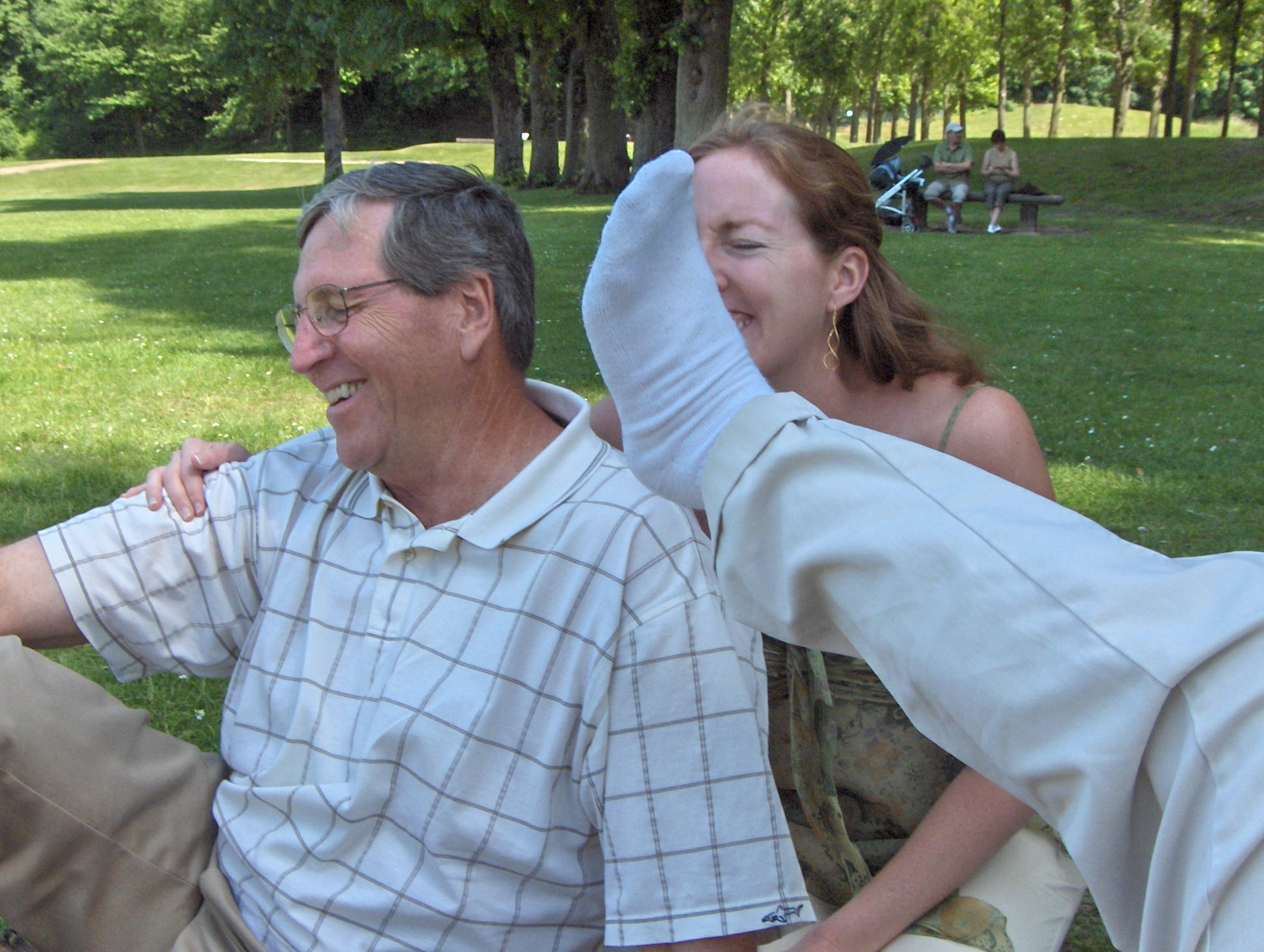
I'd rather have my brother stick his foot in my face while I'm posing for a sweet picture with my dad in France than study from notecards.

I’d rather have my brother stick his foot in my face while I’m posing for a sweet picture with my dad in France than study from notecards.

I need to build associations and habits, not stare at cards. I need to think and speak in French when I go to the grocery store so that I know it’s “la” banane and “le” brocoli. I need to look around my house, think about, talk about the objects I use every day. Le livre. La cuillère. Le four. La table. And so on.

I just want a simple rule or two to follow, but that’s not how French works. It’s going to be a long process before this whole gender thing comes naturally, and accurately, for me.

Yet here are couple that have stuck in my brain for years: problème is masculine and solution is feminine. Hmmm.


Chez Nous, On Parle Franglais


64Before kids, conversations between my husband and I were mostly English, sprinkled with some French here and there, or, after a trip to France, a healthy dose of French with a sprinkle of English. Sometimes we spoke more French deliberately – so I could practice, or so we could have “secret” conversations when out on a date (so scandalous of us, that randy young couple! In truth, we were more likely talking about something mundane like work, or gossiping about our waiter). Sometimes we’d do it so we could make fun of each country’s accents: I’d don a thick, affected French accent, complete with a nose in the air and a French shrug, and my husband would try to emulate a New Yorker or a Texan. Sometimes we bounced back and forth between languages without it consciously registering, until we noticed someone staring.

Now, as our kids (age 3 ½ and 19 months) progress in this bilingual environment, we see that in our house, we all speak Franglais.

My daughter, the oldest, had the opportunity to attend a French Immersion school last year, so her French comprehension is great, but she prefers to answer in English. We’re bribing her with her favorite foods to get her to respond to us in French: “You want another chip? Il faut parler en français !” (Another mommy fail – I once declared I’d never bribe my kids with food.)

If she doesn’t know a word in French, she’ll say the word in English with a thick French accent: for example, “soccer ball” becomes “sew-care bowl.” This, despite neither of us ever pronouncing English words in this way. I love it. Sometimes, she’ll babble nonsensical words, but the sounds are distinctly French, and she’ll tell me that she’s speaking in French when I ask her what language she’s using. The other day, she said the character in the book we were reading was “Rose-ing the lawn.” (The French word for “to water” is “arroser.”) She’s gotten used to hearing from her Papa, “Fait pas de bêtises,” (don’t goof around), so the other day she told me, with a mischievous grin, “Mommy, I’m bêtise-ing.”

In the summer, when mosquitoes abound, I tend to say, “I’m getting MANGED!” (Manger – “to eat” in French) instead of the more common, “I’m getting eaten alive,” or, “I’m getting attacked by mosquitoes.” I suppose this isn’t helping anyone in the house learn French.

Then there’s the word “doudou,” (sounds like “doo-doo”) which is the French word for “lovey,” or stuffed animal. It’s one of my son’s first French words, and one that my daughter uses commonly. As in, “Where is my doudou?” Or, “I love my doudou,” and, in response to Mall Santa’s question, “What do you want for Christmas?” “A Mickey doudou and a Minnie doudou.” That earned me a stern look from Santa, and required a lot of explaining to my confused, but ready-to-milk-it-for-all-it-was-worth, brother.

IMG_7206My son’s language is starting to take off, so I therefore poo-pah all the nay-sayers who claim bilingual kiddos will be behind in their language development during their first few years of life. Both of my kids understand French and English without difficulty, and are well beyond the “normal” expectations of spoken language ability for their ages. His first French words have been: “coucou” (hello, familiar), “doudou,” “l’eau” (water), and, my favorite, “Pi-pah-po” for “papillon” (butterfly).

My favorite misused word in English: “Happies.” When my daughter was first learning to speak, she had a set of pajamas that said, “Happy” across the chest. So, we would point and say, “Happy,” every time she wore them. Thus, pajamas became “Happies,” and we all put on our happies each night before bed. I can’t think of a better word to describe the most comfortable of clothes and the relaxation one feels when finally getting to slip into them at the end of a long day.

I don’t believe that my kids are confused. My daughter knows very well which words are French and which ones are English, despite sometimes using them in sentences together. I know, because I ask her – is that a French word or an English one you just said? As for my son, chances are he’s mélange-ing the two (see, there I go again) without realizing it. I have no fear that both kids will eventually sort the two languages out in their own brains; research shows that bilingual children eventually do. In the meantime, their prefrontal cortexes are getting an excellent workout.

I’m okay with a little Franglais. It’s one of my favorite languages, and one we’re all fluent in, chez nous.

Photo Day: Christmas in the Alps

I haven’t been to France in over two years (a toddler and a preschooler on a plane… I wish I were so brave), so many of my photos are older. These are from a Christmas we spent in the French Alps, in a small mountain village called Samoens. A beautiful, charming place, where we stayed in a cozy converted farmhouse, read books (the house had quite an Asterix collection), and indulged in Raclette after days spent on the slopes. It was my first Christmas away from my own family, so I learned of some of the French traditions my husband grew up with. Midnight mass (3 hours! We Presbyterians shudder at the thought), bûche de noel (yule log), and real chestnuts roasting on an open fire served in the village at their Christmas carnival – it was charming and so different from my own traditions. It was here, too, that I first saw Le Père Noel est une Ordure. I sat there, perplexed and not understanding, while my husband, his brothers, and my sister-in-law rocked with laughter and called out lines before the characters. Now that my French is better, as is my understanding of French humor, I find it pretty hilarious, too.

Here’s the charming farmhouse we stayed in, taken before the snow came:

035 Le Ferme

137 Le Ferme

Some photos of Samoens:

025 Fountain in Samoens

026 Samoens

139 Samoens

Twelfth century church where we attended mass . We sang Angels We Have Heard on High, one of my favorites, in French:

141 Samoens

The Alps, near Samoens:

045 Alps

075 Alps

055 Alps

060 Alps

070 Alps

Early morning frost:032 Frost

A visit to the nearby village of Annecy, with me obviously American in my running shoes:

091 Annecy

093 Annecy

097 Annecy

100 La Roche sur Foron

La Roche sur Foron

098 Annecy

And skiing in Alvoriaz:

130 Carol

135 Alvoriaz

An American Teaching French – One Child at a Time

This post is written for this month’s Multilingual Blogging Carnival, hosted by Discovering the World Through My Son’s Eyes. Check out the link for more great posts!

I got lazy last year. Having our daughter in a French immersion preschool made it so easy. French surrounded her. Everything she learned was in French. French was cool, because everyone else was doing it.

Now, I have to step up my game. I’m trying to find ways to keep French active in our lives. But my fears are coming to fruition: my daughter is starting to resist French.

No one around us speaks it, here in Colorado. Her schoolmates all speak English, and now that’s all she wants to speak. We haven’t connected with the French community here, though we remain hopeful about finding it.

Bringing Up Baby Bilingual has been my reference bible for French activities in this area. I know there are a surprising number of opportunities here, we just have to look a little harder than we did in San Diego. Here’s what we’re doing so far:

We have attended story times. I feel like a desperate twenty-something dude in a club on a Saturday night, frequenting these story times, eavesdropping on conversations, trying to find another mom, hopefully speaking French to her kids, who might be willing to fork over her digits and set up a play date.

Meanwhile, since we don’t have any French-speaking friends here yet, and since my husband is putting in a lot of hours at work, it’s on me to make sure French is a part of our kids’ daily lives. Here’s the real kicker: I’m resisting it. I hate to admit it, but it’s true. Because I’m not truly me in French (see this post). My affection for my kids comes in the form of “honey” and “sweetheart”, not “mon petit chou” (my little cabbage. Ewww.). A French teacher once pointed out to me that “honey” is gross to her, because it’s sticky and messy. I suppose I can see her point. I do find myself, for whatever reason, resorting to French when I need to be stern with my kids. “Assieds-toi !” When my son stands in the bathtub and starts jumping around.  “On y va ! Vite !” When we’re late. French sounds scarier to me, and they jump to attention when I speak in French where they ignore me in English. I can already see their conversations as adults: “And when Mom started in on us in French, that’s when we knew we were in trouble!” Come to think of it, perhaps this is not the association I want to build….

Our bilingual bookshelf

Our bilingual bookshelf

We have plenty of French books, and I struggle here too because I focus too much on making sure I’m pronouncing everything correctly rather than immersing us in the story with an animated reading, the way I do so easily in English. Still, I’m trying. The more familiar each text becomes, the more fun I am when I read it, and the more attention my kids give me when I pull one of these books out.

DSC01178

Music. We listen to French music all the time. My daughter asks me to play, “Dansons la Capucine” every time we get into the car. French music is her music, anything in English is “Mommy music.” Sometimes she’ll tolerate a Mumford and Sons song or two before saying, “Mommy, I want French music! Dansons la Capucine!”

DSC01182

I’ve ambitiously (Naively? Stupidly?) offered to do French activities and story times at my daughter’s preschool for any kids who are interested. I’m scaring myself with this one. The mere thought of trying to put together a French lesson for a bunch of 3 and 4 year olds is giving me performance anxiety. If you know me, you know I don’t do anything half-way. I’m all in. Type A perfectionism overachiever at its most intense. I don’t cut myself any slack. I’ll nitpick at myself for mispronouncing one of those ridiculous vowel sounds until I’ve convinced myself that I’m unworthy of even attempting French. Stuart Smalley, care for a session in front of the mirror with me?

I know they say a language can’t be taught through TV, however, my daughter adores La Maison de Mickey and asks to watch it daily. So, a few times a week, I turn on an episode (Thank you, Roku). She does, in fact, pick up a few new words each time. We talk about the show in French, then we all do the Mickey dance together.

DSC01177

The other day, she pulled out a stack of French flashcards and handed them to me. “Mommy, can you do these with me so I can learn French so I can talk to my cousins?” Again, flashcards get a bad rap, but I wasn’t about to deny her a learning opportunity. I was pleased to see that she remembered a ton of vocabulary words in French. I often ask her to tell me what different things are in French. My husband and I try to both speak French when we are all together, and when the kids say something in English, we translate it into French, then ask them to repeat it. Incidentally, my son’s first French word is, “Coucou !” Translation – a form of “hello” mainly used with families and children.

As for my own learning, I’m planning to crash a French class or two at the University of Colorado in Boulder next semester. When I’m excited about the language, I can pass that on to my kids. Taking classes always makes me happy – if someone would pay me to be a student for the rest of my life, I’d take that job in a heartbeat. I remain determined that my kids learn French, and that it is not a secret language they share with their Papa only.

I believe that plugging into the French-speaking community here is our best hope for ensuring that our daughter and son, and me too, speak French fluently. Like many things, this will take time. And I still dream of a summer in France, maybe in a few years, when the kids are older, where the kids and I all take French lessons. Actually, I’d be fine with a yearly French immersion. Complete with lots of bike rides, croissants, and crepes. That would work for me.

Trader Joe's croissants for now... whenever TJ's opens in Colorado!

Trader Joe’s croissants for now… whenever TJ’s opens in Colorado!

As always, we remain determined, if a bit daunted, to raise our children bilingually and biculturally.
What is Assimilation, Anyway?

I often meet people, my age or older, whose parents immigrated to the U.S. and intentionally avoided teaching their offspring their native language, believing that it would both inhibit their child’s ability to learn English and interfere with their assimilation into American culture. Every one of these now grown “children” expresses regret that they didn’t learn their family’s native tongue.

How times have changed. We now understand that, especially for young children, learning two or more languages is not only possible, but developmentally advantageous. Immigration laws have changed. Our world, too, is smaller. Once upon a time, people boarded a ship knowing they would never see their home country again. They were forced to cut all ties and make a home in the place they landed. Now, we are a Facebook or FaceTime exchange away; we can hop on a plane and be almost anywhere in the world in less than 24 hours, and we can easily find others like us wherever we are: just Google a meet-up group for whatever suits you.

We don’t have a standard definition for what “First” or “Second-generation American” means. Is the first generation the one that did the immigrating? Or the first generation born in the U.S.? As for the term “assimilation,” multiple studies aim to determine how immigrants are assimilating but struggle over how to define what assimilation actually means. Do we measure it by learning English (or the native language of whatever country is being examined)? By civic participation – becoming a citizen, becoming involved in some way? By cultural participation? Did your kids dress up for Halloween? Did you stuff yourself with turkey and mashed potatoes on Thanksgiving, then cheer on your football team while indulging in pumpkin pie smothered in whip cream from a can? Some studies look at economic achievement: jobs, home ownership. Others attempt to examine patriotism. Even more difficult to define: do immigrants feel American? And what does that mean, when even the idea of the “typical” American can vary so much, depending upon what region of the U.S. we are considering? What exactly is the essence of Americanism? Or being French?

Most bicultural or non-American families I know raising children today diligently work to make sure their children know their native cultures and native languages. They fear their children will grow up unable to communicate with family back home, or unfamiliar with what to our friends is so familiar. They embrace many of the traditions and culture of their chosen American home, yet they actively retain their own cultures as well. For us, in our French-American home, the blend is mostly easy. We both already celebrated Easter and Christmas. For my husband, Halloween and Thanksgiving are fun new holidays (though no self-respecting Frenchman would ever stuff himself silly. As for American football… he’s making valiant efforts at appreciating the sport). I had no issue with long meals full of visiting and drinking wine more often. We were both happy to have an extra holiday in July for fireworks and barbeques. Sometimes I think we should move to France just so we can enjoy May, where public holidays mean a month of, well, joie de vivre, and August, where the whole country goes South for vacation.

The challenge for most of us remains teaching our children the second, non-English language. In San Diego, multicultural families surrounded us. One time at the playground, I counted seven different languages being spoken. Seven. We were the norm there – multilingual, multicultural. Here, in Colorado, I rarely hear a foreign language. And for the first time, I feel self-conscious when I speak to my kids in French. People stop and stare. I assume it is because it is so, well, foreign here.

We have no doubt our kids will learn English. With our American family, school, me, and peers, they’ll have plenty of exposure. Unlike many of the families from generations past, we desperately want our kids to speak French and to know their French heritage. We hope they are proud of their unique cultural make up. We hope they can feel at home, that they will have a sense of belonging, in the U.S. and in France. It’s the changing face of our world – a multilingual, multicultural, small world. Where we embrace rather than disconnect from our heritage, where we are proud to speak another language, where diversity is a beautiful, colorful thing.


The French Version of Me

Something strange happens whenever I go to France. I morph into a slightly different person.

I’m not pretending to be someone I’m not. I’m not even on my best behavior. No, it’s about the language. I can’t quite be myself in French.

In part, my French is not fluent, so I always feel I’m in a bit of a fog, not completely able to hear, understand, or express myself. But there’s more. My sarcasm and dry humor don’t often translate. I’ve tried, and more often than not I end up getting confused looks or worse, offending people. In French, I tend to be quiet and withdrawn, while in English I am extroverted, confident, sometimes even gregarious. I tend to be much more serious in French; again – my humor doesn’t translate. In English, I tease and joke with everyone and I constantly poke fun at myself. I’m not there yet with my French. Instead, I resort to a goofy, unsophisticated sense of humor that relies heavily on facial expressions and body language, whereas in English I’m known for being so deadpan people can’t always tell if I’m joking.

I phrase things differently. In English, I can be precise with my word choice, allowing myself to be diplomatic or irritated, straightforward or sarcastic, serious or funny. In French, I must rely on my limited vocabulary, gestures, and an exaggerated tone of voice, making me wonder if I come across as dense. It’s so easy to misinterpret what I hear or to say something I didn’t intend to say. Like my wedding vows or the time I announced “Je suis femme !” (“I am woman”) when what I intended to say was: “J’ai faim !” (“I’m hungry.”)

There’s also the inherent cultural aspects of a language. French speakers tend to be more animated, their voices sometimes almost sing-songy. I find myself adopting this mannerism as I speak French. I start doing the French Blow. French speakers tend to repeat short phrases. I say this is because they are always talking over one another, so they have to repeat the same things over and over in the hopes that someone will hear them eventually. In English, I would find this repetition annoying but it seems to be simply  part of the language in French.  I tend to adopt this mannerism as well.
Yet it cuts deeper than the way I express myself, it affects the way I think. Of course, there’s no direct, word for word translation from any one language to another. Getting to the level in a language where you actually think in that language is an exciting milestone to reach. Then, it has become a part of you. Language shapes our minds. So much of a culture is wrapped into its language, and vice versa. When living in a foreign language, our very core changes, sometimes subtley, sometimes more.

Pas Mal

We visited a French friend’s home recently for the first time, and when I walked into their La Jolla area abode, complete with floor to ceiling windows and a spectacular view, I exclaimed: “This is such a fabulous house! Wow!”

My friend answered, with an indifferent shrug, “C’est pas mal.”

I stared at him. “That’s such a French answer.”

“Oui. There are some that are better, some that are worse, so: pas mal.”

And there you have it: French culture and American, juxtaposed. We Americans tend to be enthusiastic, perhaps overly so, of even the most mundane of things. “Oh my god, there is nothing better than potato chips. These ROCK.” Everything is awesome, amazing, choose your superlative. The French, on the other hand, can’t seem to muster up excitement about anything.

There’s little difference, for example, in how they describe something that’s great versus how they describe something that sucks: “C’est pas mal.” It’s not bad. This describes anything from something good to something fabulous. Then there’s: “C’est pas terrible.” Literally: It’s not terrible. This describes something awful.

As an aside, the word “terrible” in French is almost always used in the negative, except when it’s not, like here: C’est un truc terrible. Translation: It’s awesome.

Then there’s the typical response to someone proposing a great idea. Here, we’ll say, “What an amazing idea!” or something equivalent. The French will more typically say, “C’est pas bête,” Translation: That’s not stupid.

It’s easy to assume from all of this that Americans are shallow, fake, insincere, and that the French are a bunch of negative duds. No wonder we have so much trouble understanding each other!

Our interpretations of others are colored by our own biases, opinions, experiences, and of course, our cultural understandings. It is easy to generalize something, as I have above, that in truth is much more complicated and nuanced.

It’s also true that my friend’s house is really freaking awesome.


Staycation for the Summer

Me, with a serious frou frou drink on our honeymoon

Me, with a serious frou frou drink on our honeymoon

The following is a post for this month’s Raising Multilingual Children Blogging Carnival hosted by All Done Monkey. This month’s theme is Multilingualism and Travel. Click here to read great posts from others. 

Once upon a time, it seems so long ago, summer meant packing our bags for an adventure, or two, or four. I prided myself on my ability to pack for two plus weeks in a carry-on. Over glasses of wine uninterrupted by children who needed to use the potty or who wanted to eat NOW, we vowed that we wouldn’t fall into the trap so many of our friends had, we would keep traveling, having adventures, and our kids would simply come along for the ride. I look back on those evenings and it’s like I’m watching a sit-com; I double over in laughter and point at the former me and say: “You think you are so savvy, so above it all, BWAH HA HA! Just you wait!”

Thing is, in my mind I skipped right over the toddler years and straight to kids that were able to talk, bathe themselves, and walk more than a quarter mile before needing to be carried. I didn’t think about the car seats, Pack ‘n Plays, nor the strollers that would need to come with us. Hotels equipped with cribs, restaurants with high chairs… not even on my radar. I definitely didn’t envision a full-blown tantrum in any of these scenarios.

We took our daughter to France when she was nine months old. She did great – there were almost no tears until the last leg of the flight there, at which point she’d reached her limit. She screamed – SCREAMED – for an entire hour, and nothing we did could comfort her.

Then there was the train ride from Brittany to Paris. We had our suitcases – three – plus a stroller, plus her car seat, plus a diaper bag and a backpack. The train station had one elevator. One. The elevator held about three people with one bag each. The group waiting to board the elevator was fifty deep. Each trip on the elevator took four and a half minutes. Seriously. I timed it. To make it even more complicated, the platform wasn’t announced until 10 minutes before the train was due to take off.

This was France, mind you, where a line is more of a group of people pushing and ducking and manipulating their way past all the others. There’s no polite and fair waiting your turn. It’s survival of the fittest, and they aren’t above shoving past a woman and her stroller, or even shoving that stroller. While I complained about it, Stéphane took the stroller and turned it into a battering ram. When in France…. We pushed our way to the front of the group, made it to the platforms, and sprinted – he dragging two bags and wearing the backpack, me pushing the stroller/car seat and dragging our third bag with the diaper bag slapping against me and knocking me off balance. We boarded and the train immediately began to move.

Then I realized I had a diaper to change. The train had one car – one – with a diaper changing table, but I couldn’t find it. I ended up sitting on a toilet seat, my feet braced against the wall and my legs a makeshift changing table with my daughter stretched across them, rocking precariously every time the train hit a curve.

Then

Then

So, other than a small weekend trip up the coast, we aren’t going anywhere this summer. I’m intimidated by the thought of traveling with a one-year-old and an almost three-year-old overseas. Next year, we hope to go to France and spend at least a few weeks there. It’s obviously important that our children know their French family and their French heritage. And that we eat crêpes. Lots and lots of crêpes. There are all sorts of opportunities for family language vacations throughout France, where the three of us could enroll in language courses and really immerse ourselves. Plus, with my husband’s French citizenship, there are options for sending the kids to summer school there. Soon, while they’re young, before they realize that school instead of lazy summer days equals Mean Mom.

But here’s the silver lining: We live in San Diego, a top vacation destination for so many. All it takes is a morning at the beach, my toes in the sand, watching the surfers, for me to feel like I’m on vacation.
Now

Now

My daughter’s preschool lets out this week. She’s made so much progress with her French over this past year, but soon she will be home with English-speaking me every day rather than at school with her native French-speaking teacher and French only classes. I’ve been so worried that she’ll lose all she’s gained. Then I realized –hey, my French is decent. It’s certainly better than nothing. So we’ll be tourists in our own city, but we’ll do it in French. San Diego Zoo day, where we learn the animal names in French and talk about what they are up to. We’ll learn what noises they make – in French! Sea World? Lego Land? Balboa Park? The Embarcadero? The beach? Oui oui! Ce n’est pas mal!

I mentioned my idea to another mom at the preschool, and she quickly said she wanted to join us with her kiddos. Then another mom. And another. So my little idea just became a big deal – most of these families are not French speaking, so I’ll be leading the charge with our efforts to keep the kids progressing in French.

I still vow to get back to traveling adventures. I haven’t given up the dream. It will just hopefully be without a diaper bag.

French Children’s Books

 A friend of mine sent me this link to an article published in the Guardian on Terrifying French Children’s Books.

I’m torn in choosing a favorite among La Visite de petite mort (Death visits a little girl. He kills her), Le Voleur de Lily (The Thief of Lily – Lily is kidnapped), or Le Jour où Papa a tué sa vielle tante (The Day Daddy killed His Old Aunt – true crime for 7-year-olds).

French children’s books, like French movies, aren’t big on the whole “and they lived happily ever after forever and nothing bad ever happened again and everyone was delighted for always” endings. Moral messages don’t seem to be present in many books, either.

We are amassing a collection of French children’s books in our home. There’s one collection of pop up books that particularly caught my eye for their great art and classic stories, so I ordered several of them from Amazon.fr. Then I read them. Starting with Le petit poucet. Petit Poucet (Little Thumb) is the youngest of seven children. His parents run out of food and decide to abandon their children in the forest. Petit Poucet leads his siblings back to their home, so their parents take them out and abandon them, again. Successfully, this time. The children are captured by ogres who plan to make a fine meal of them, but Petit Poucet tricks the ogre into eating his own children instead. Woo hoo! Happy ending!

That book is no longer in our house. I can just hear my daughter every time we go hiking: “Mommy! (sob, sob) Are you going to leave us here so the ogres can eat us?”

There’s the classic: Alouette, gentille alouette. How many people actually know what the words are, other than the chorus? It’s about plucking all the feathers from the bird, then dismembering it. Slowly. While singing an upbeat tune. But the pictures are so pretty:

DSC00415

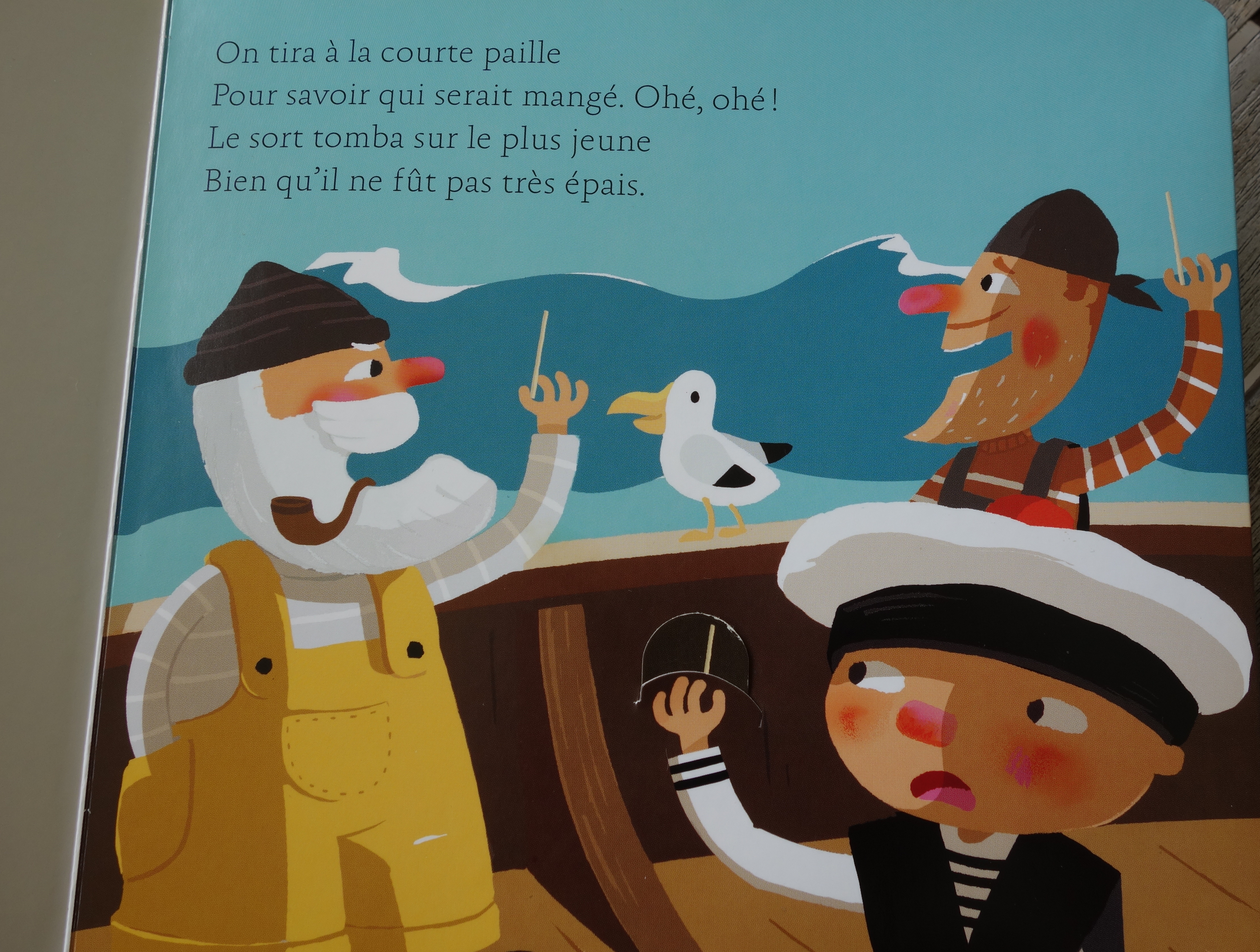
Il était un petit navire: There was a little boat. The sailors run out of food and draw straws to decide which crew member will be dinner.

DSC00416

A little boy draws the short straw and as the men discuss how to cook him and what sauce to use, he prays to the Virgin Mary to save him.

We're coming for you, little boy, with our sharp shiny knives!

We’re coming for you, little boy, with our sharp shiny knives!

DSC00418

Happy ending! She does. In our version, anyway. Not so much in the traditional tale.

This pop up picture causes my poor son to burst into tears, every time. Le chat botté (Puss in Boots) is pretty freaky here:

 DSC00421


Granted, plenty of our nursery rhymes, songs, (Ring Around the Rosie, anyone?) and old fairy tales aren’t exactly geared for the modern child. But so many have been Disneyfied that we’ve become accustomed to happy endings, justice being served, and a palatable moral message. Though I still have huge issues with the Little Mermaid. She gives up her home, family, fins, and voice for a man? Ugh. Yes, honey, but the prince is so handsome!

Many of our most familiar fairy tales were first penned by Charles Perrault, a Frenchman who lived and wrote in the 17th century and who is known as the initiator of the literary fairy tale. Cinderella, Puss in Boots, Sleeping Beauty, Little Red Riding Hood, Blue Beard, and my favorite: Le Petit Poucet… all come from Perrault. He called his collection: Tales of Mother Goose. Château de Breteuil, just outside of Paris, has plays and displays all featuring the tales of Charles Perrault, plus beautiful gardens to wander through.

Beauty and the Beast, or La Belle et La Bête, was written by frenchwoman Jeanne Marie LePrince de Beaumont (the version as we best know it).

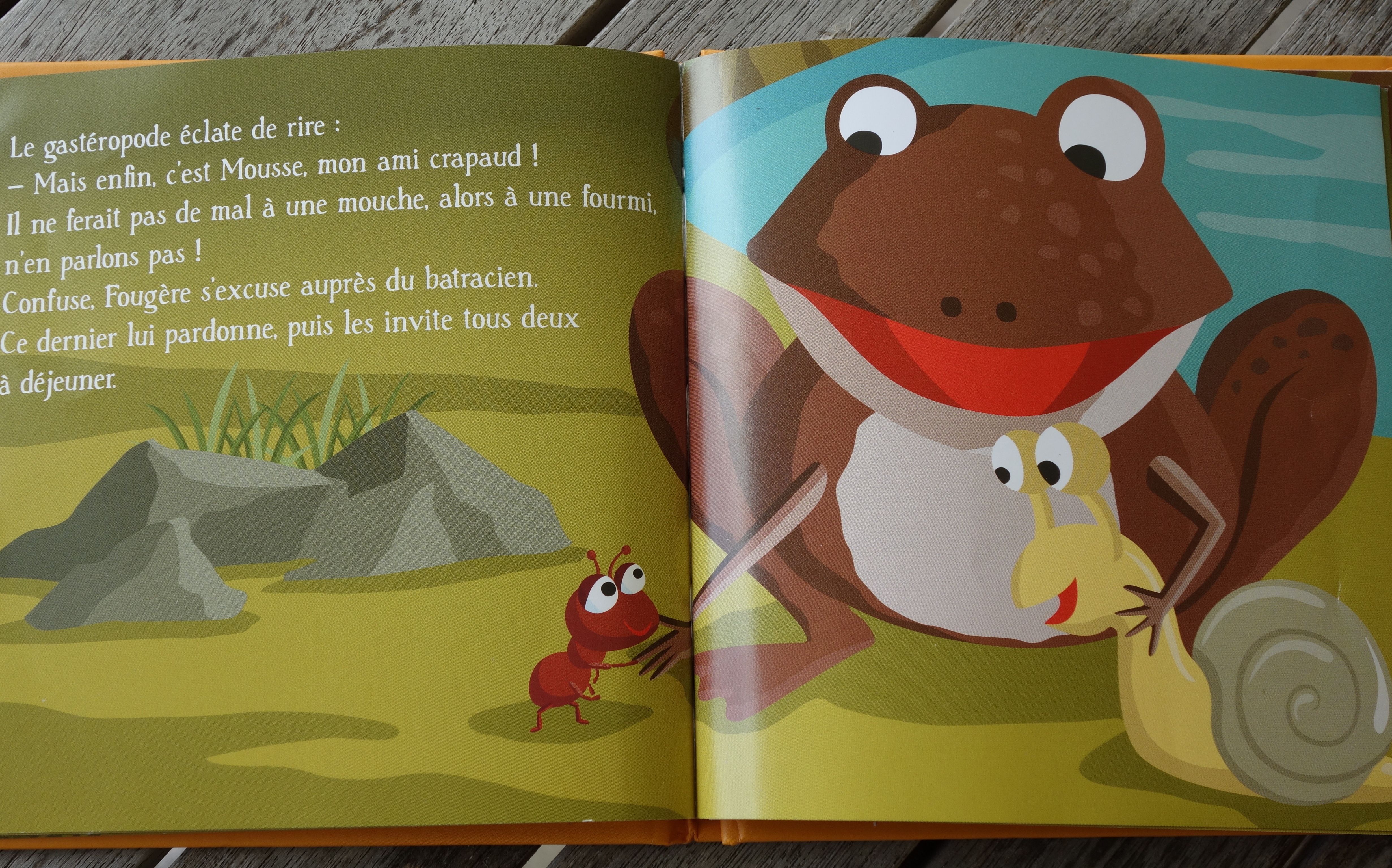
We have found several books that we enjoy. I love this little book, especially the illustrations, that I found on our last visit to France: La Fourmi voyageuse: The adventurous ant. It’s about a hardworking ant who is persuaded by a snail to leave his work and explore the world – “there’s hundreds of you working. No one will notice if you are absent for a moment!” The ant decides to ditch work and explore and he has a wonderful adventure and makes new friends:

DSC00424

When he returns home, he tells the other ants of his adventures. The queen decides to give each ant some free time so they can all explore the forest, too. Hmmm. Sewing the seeds of, oh dear, dare I say the icky word, socialism? Pretty soon those ants will be expecting eight weeks vacation and free health care.

DSC00425

The Petit ours brun series and T’choupi, both of which are also cartoons that are easily found on You Tube, are favorites.

DSC00422

DSC00423

Babar is also one of my daughter’s favorites, though Babar’s mother is killed by a hunter (much like Bambi). We skip over that part for now.

DSC00431

Misbehaving Mini-Loup (little wolf) is always wreaking havoc:

DSC00426

But he usually pays for it:

DSC00427

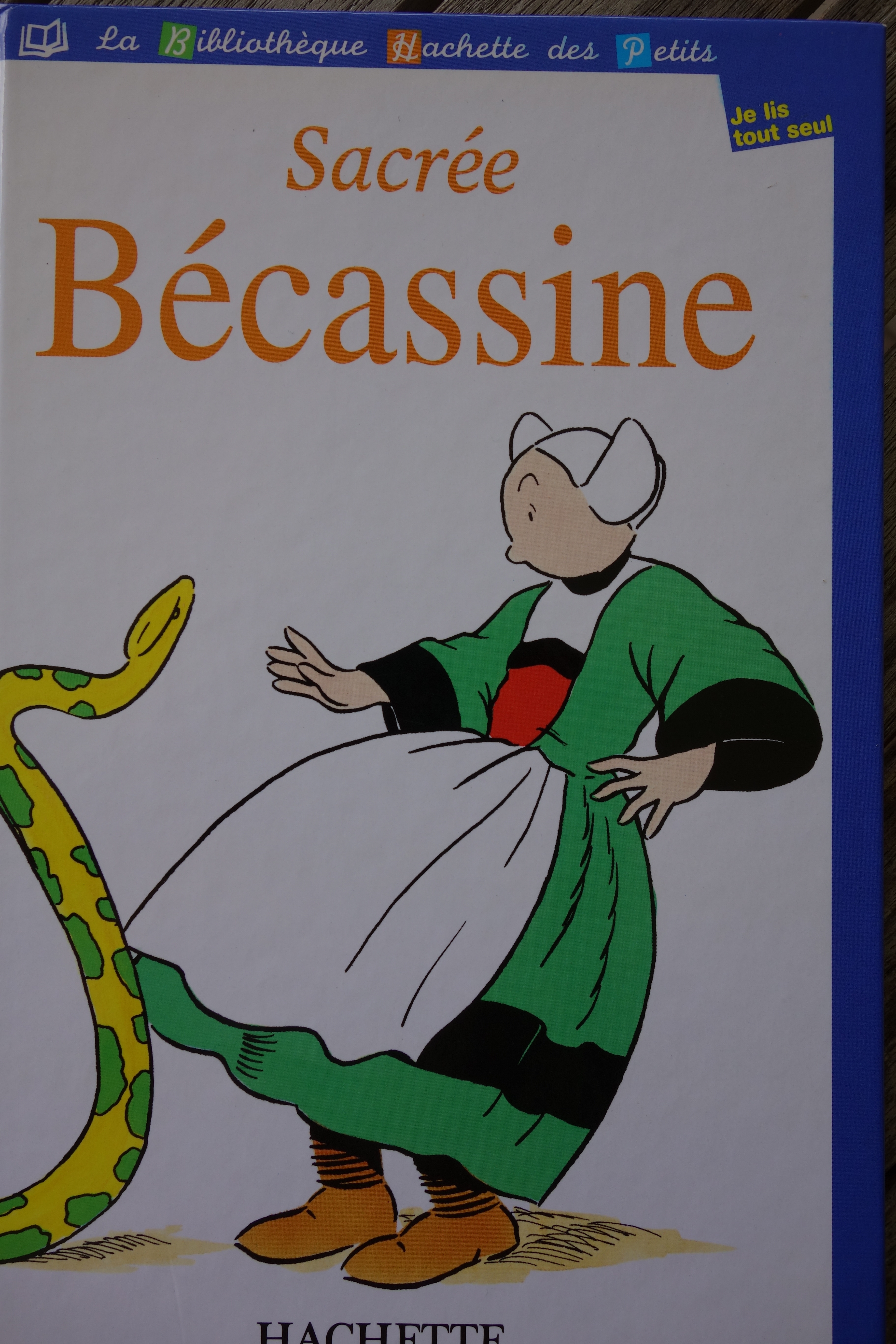
Then there’s Bécassine, the French version of one of my English favorites growing up: Amelia Bedelia:

DSC00428

I look forward to visiting bookstores next time we’re in France. Any suggestions out there for children’s books we should read?