Unknown's avatar

About A French American Life

Carol writes fiction and blogs about her bilingual, bicultural life. She lives in Colorado with her French husband and their two children.

Merde

Often, when we learn a new language, the first words we learn are the swear words. This was true for me with Spanish – as a kid, when my dad worked on the family car, I learned all sorts of fantastic Spanish words. Perhaps he believed that if he swore in a different language, his impressionable little ones wouldn’t pick up on it.

Oh, but we did.

With French, though, it was different. I began studying French when I was 28 with the sweetest, most patient French professor ever. (Madame Loiseau – merci pour tout!) I didn’t give much thought to enriching my vocabulary in that direction; I needed to say “hello” and “goodbye” and “sorry about that, I’m a huge klutz.”

A year later, while living in Paris and attending a French immersion program, I spent mornings before school watching Inside the Actors’ Studio, broadcast in English with French subtitles. The host, James Lipton, always wrapped up the show by asking each actor he was interviewing the same five questions, one of which was, “What is your favorite curse word?”

Thus, I learned the good stuff.

The funny thing, though, is it all sounds like nonsense to me. A lot of these words have no direct translation, and since I don’t always know the connotation and I’m not used to hearing them used, I don’t have a good feel for how vulgar or tame they really are. Merde, for example, is somewhere on the scale between “crap” and “shit.” A kid will get in trouble for saying it, but an adult throwing it into normal conversation, even in a French class, will at most garner a few giggles. The word putain is listed in my French/English dictionary as “whore” or “goddam” or “bloody” if you’re British. But actually it’s France’s equivalent of the “f” word.

Enter my brother-in-law. I adore my brother-in-law. But sometimes, when he talks, I wonder if I really do speak French at all. He uses so many colloquialisms and slang words, plus he mumbles, so I can hardly follow what he’s saying. And – he’s got a potty mouth.

I learned some new words from him on a trip to France a few years ago. A woman walked off the train with his suitcase when he came from Lyon to Antibes to visit us one weekend.  Several hours later, she called him to let him know about the “mix-up.”  When he hung up his phone, he said, or rather yelled, “Grosse Conne!”  Literally, it translates to “huge idiot.”  No big deal, right?

Back in Paris a few weeks later, we were joking with my brother-in-law about the incident, and I mimicked the way he had yelled at his closed cell phone. I didn’t quite yell it, but I said it loud enough that my mother-in-law came running into the room in a state of panic and cried, “C’est Carol? Ce n’est pas possible!” (“Was that Carol?  It couldn’t be!”)  I suddenly felt like I was a misbehaving twelve-year-old. So I did what any twelve-year-old would do: I blamed it on someone else. “He taught it to me.” Turns out grosse conne is quite a bit more vulgar than “huge idiot.” Which is impossible to know unless you spend time around native speakers and embarrass yourself several times. I try to take the safe route – I want to know these words and phrases so I can tell if I’m being insulted, but I tend to not say them.

Except for merde. I like that one.

[Full Disclosure: This was originally published on my author website in 2008]

More French, Please!

Our daughter comes home from preschool singing adorable French songs like these:

It’s clear that she understands everything said to her in French. She’s also a great translator:

“Mommy, where’s my shirt?”

“Here’s your shirt, sweetie. How do you say ‘shirt’ in French?”

“It’s ‘chemise,’ sweetie.”

(Yes, she calls me sweetie.)

In her mind, there is a clear distinction between the two languages. She’ll pull a book from the shelf and tell me, “This book is French.” She’ll tell me her teacher speaks French but so and so in class speaks English.

It amazes me that at such a young age, 29 months, such a clear line can be drawn. Even my 9 month old son will pause and stare at me when I speak French. He knows something different is coming out of my mouth. Recent research shows that babies as young as 7 months can differentiate between languages. Fascinating.

Right now, though, our daughter tends to speak mainly in English or occasionally Franglais. She knows she’s doing it; she seems to pick and choose the words she likes or the words she finds easier to say. Like the other day when trying to give my husband a bite of her cereal: “Papa, open your bouche!” Or this morning, when I was failing miserably at corralling her to get her dressed for school: “Mommy, I want to play cache-cache!” (hide and seek).

Parents in other bilingual households have advised us that when she responds to my husband with English to tell her, in French, “I don’t understand. Tell me in French.” We’ve been hesitant to go this route; the last thing we want to do is shut her down when she’s trying to express herself and we certainly don’t want her to hate French. So right now, when she says something to my husband in English, he translates the phrase into French and has her repeat it back. She seems to think this is great fun.

We’ve also started speaking French more at home. My husband has been in the U.S. long enough that speaking French feels unnatural to him. We both have to put forth a lot of effort to have a conversation in French. But I need the practice, and it’s great for the kids. Lately, our daughter will even tell me, “Mommy, I want to speak French with you.” (Despite THIS)

Going to a French school helps, I have no doubt. We are in that window of opportunity, where her mind and her palate can take in our two languages and form the sounds without the flaws and struggles that I must deal with as a later in life language learner. It’s fun to see her French taking off, and fun for me to work on it with her. Our mission: more French speaking in our house, and trying to keep it fun so the kiddos (and I) don’t rebel against it.

Please Forgive Me, I’m an Anglophone

How is this for an ego crusher: as I was reading a poem by Verlaine in preparation for my French class, my daughter said, “Stop Mommy! You’re hurting my ears!” then clapped her hands over her ears to emphasize her point.

Ouch.

I’m telling myself that she wanted a quiet breakfast rather than my French being so abominable that even a two-year-old couldn’t take it. But still.

From my first words, usually “bonjour”, I have an accent. My husband assures me it’s a cute accent, but I’m self conscious about it. My French class is causing me to second guess everything I thought I knew about how French words are pronounced. I’ve decided that’s a good thing – I’m tearing out my bad habits and rebuilding with better fundamentals.

In France, the locals know I’m foreign, but often they don’t recognize that I’m American because my accent is less obvious. One of my most memorable experiences happened when I was studying in Paris. I traveled to Strasbourg one weekend to visit some friends and we went to a huge party where I was hit on repeatedly by French men of varying levels of charm. It was the accent that seemed to draw them to me and I started to feel pretty sexy and charming myself right up until this encounter. A French guy approached me and said something that I didn’t understand, so I said, “Pardon?” My accent immediately made it clear that I was not-from-around-here.

So he switched to English. “Where are you from?”

This was 2004, the height of America-hating, and not 10 minutes before I’d had to endure a diatribe about why Americans suck (from a guy who was simultaneously doing everything he could to get into my pants), so I wasn’t too eager to reveal my origins. Instead, I said, “Paris.”

“No, really, where are you from?”

“I’m from Paris.”

“You look Irish. Are you Irish?”

I shook my head.

“British?”

“No.”

“Scottish?”

“No.”

“Welsh?”

I laughed and shook my head.

He tried a few more English-speaking countries, then finally, exasperated, said, “Well then, where are you from?”

“I’m American.”

“An American girl?” He wrinkled his nose. “Ugh!”

And he walked away from me. Classic.

I don’t know that I’ll ever pass for a local. That ability with a language is a rare gift. I always laugh at movies and TV shows where some spy or official is pretending to be a native, talking in the native tongue, supposedly fooling everyone. It just so rarely happens; our Anglophone tendencies will always creep into our language. It’s a rare and gifted person who can speak a foreign tongue without an accent. My French teacher at SDSU is one of those people, which gives me hope. There’s a fuzzy line between improper pronunciation and simply having an accent. I’m working on it. If only so that my kids don’t make fun of me.

Former Posts about learning French in my family:

Progress in My French Education

Rue, Rit, Roue

French Customer Service

My Daughter Started Preschool

My Daughter Speaks French

A Trip to France and Ireland (from a few years back)

We’re temporarily grounded. I haven’t been to France since the summer of 2011 – the longest break from my beloved adopted country in a decade. The thought of traveling overseas with a 2-year-old and a baby is so daunting that we’re exploring closer to home these days. We’re gearing up for 2014; that will likely be the year of our big return to France. For now, I’m going to reminisce about some of our past adventures. With photos.

We brought my family to France and showed them around Paris, including the Luxembourg Palace and Gardens:

029 Luxembourg Palace

And Versailles, where we also visited the lesser known Hameau de la Reine, a small village and garden built for Marie Antoinette:

062 M.A. garden

We traveled through the Loire Valley; here is a photo of the rooftops of Ambroise. I love rooftops in French villages:

094 Ambroise from castle

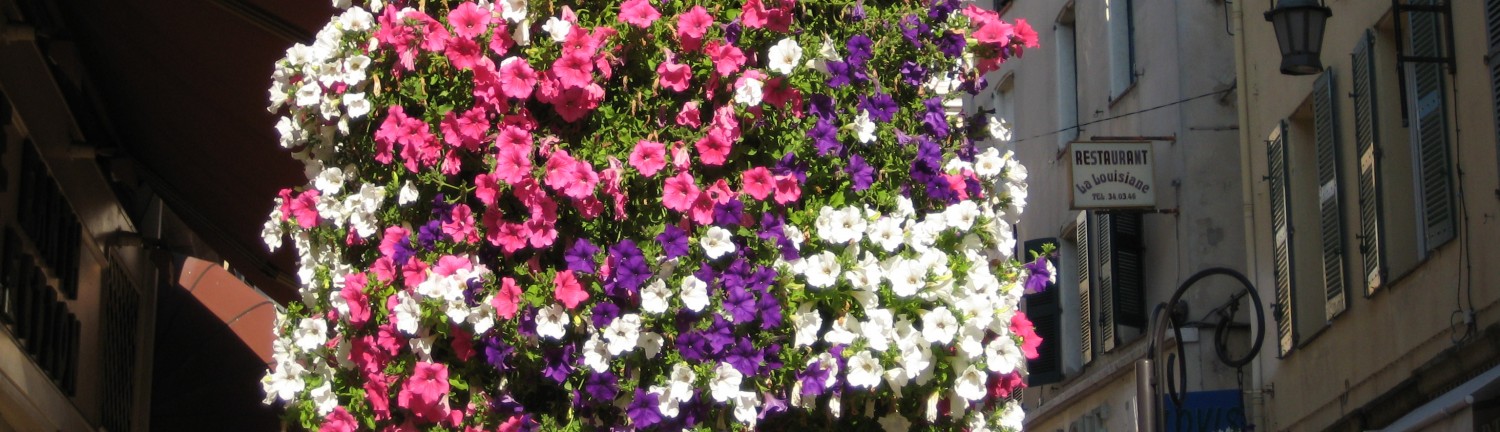
Next we went to Bretagne (Brittany), western France. Gorgeous flowers abound:

136 Flowers

Here we are in Port de St. Goustan:

154 Port de St. Goustan

My husband and I then went on to Ireland. Here I am in Kinsale, one of our favorite towns…

189 Kinsale Harbor

…where we hung out in a pub with this sign. Will you buy me a drink if I tell you?

191 Will you buy me a  drink if I tell you

Ahhh, laptop traveling. It’s not quite the same. But it will do for now.

Progress in My French Education

When I’m surrounded by French speakers, I equate the feeling to wearing a veil over my eyes. My comprehension (vision) is obscured; there is a distance between me and what is going on around me, a distance that I struggle to overcome. Initially, the veil was thick; I got hints of the big picture but I missed all the details. Gradually, that veil has become more transparent. I went from being able to only decipher a message from tone of voice and hand gestures (i.e., Wow! That guy’s really pissed about something…. Oops. It’s me. He’s pissed at me.) to picking up the gist of a conversation to where I am today: One-on-one, I understand 90 to 95% of what is said. In class, I don’t miss much. Sometimes I even feel like the veil is gone. But sit me down at a dinner table full of French people who all speak at the same time faster than a high speed TGV and I’m lost. I need the subtitles (in French is okay) turned on during a movie. Lyrics are tough. And my brother-in-law, with his mumbling and slang, is impossible.

There are so many subtleties in language – specific word choices aren’t just about vocabulary, behind them exists a history of usage and color developed through cultural evolution. Often pop culture influences our language; think, “Not that there’s anything wrong with that!” from Seinfeld, and how knowing what is underneath the simple meaning of those words deepens our understanding and appreciation for the expression. By the way, it took my husband years of living in the U.S. to finally understand the humor in Seinfeld. Emotion, body language, points of emphasis – it all can be culturally specific. I was treating a Romanian patient once (I’m a physical therapist) and every time I checked in with her to make sure I wasn’t hurting her: “Is that hurting?” she shook her head. After several minutes, her daughter stepped in to tell me that her mother was in a lot of pain. She (finally) explained to me that in Romania, a nod means no and a head shake means yes. I felt terrible, but how was I to have known?

Already I’ve taken some leaps forward with my French class this semester. The crazy thing is that it’s the seemingly tiny tips that help me the most. Here are a few I’ve learned:

  • T’s and D’s:

In English, we place the tip of our tongue on our hard palate for “t”s and “d”s. In French, they place the tip of the tongue on the back of the upper teeth. This makes a huge difference in pronunciation of the vowels following these consonants.

  • Syllable breaks:

In English, we break our words up by consonants, always searching for that next consonant (albeit subconsciously) when pronouncing a word. In French, syllable breaks occur at the vowels more often. Example:

gé  né  ra  li  té              (French)

gen  er  al  i  ty            (English)

So all these years I’ve been chewing on my consonants instead of opening up and letting those vowels sing!

  • Accentuation:  English has a complicated and nonsensical way of accenting certain syllables in certain words, and it plays a phonetic role. Imagine how complicated this is for the poor foreigners out there trying to learn our language! Look at the word defect, and notice how the meaning changes depending on which syllable we accent. In French, the accent is always on the last syllable, it’s really more a prolongation of the vowel than a true accent, and it doesn’t change the meaning of the word. Thank you, French, for finally making something less complicated!

Seriously loving this class I’m taking.

Former Posts about learning French in my family:

Rue, Rit, Roue

French Customer Service

My Daughter Started Preschool

My Daughter Speaks French

Opera

I went to my first Opera recently. We saw La Fille du Régiment (The Daughter of the Regiment). Originally set during the Napoleonic Wars, it tells the story of a regiment of soldiers who adopt a young girl who then grows up among their ranks. The San Diego Opera moved the story to World War II, so the idea that a girl would spend so many years with a group of soldiers doesn’t really fly, but as the review in the paper said: don’t think about it too much. I didn’t. Honestly, what I was thinking through most of the opera was this: I’m so flipping bored. I wonder what time Ghirardelli Chocolate closes?

I know, I know, it’s terrible. Horribly disrespectful. I can appreciate, on a technical level, what the performers accomplished. But I don’t enjoy the music. Nor did I love the story. It’s not that I don’t love a good musical or a star-crossed lovers story. This one just didn’t work for me.

Plus, I felt like I’d stepped into an alternative universe. One where a man backs his Maserati up at full speed with his nose in the air, not even bothering to glance at you because he knows you’ll get out of his oh-so-important way. Where big-breasted but otherwise skeletal young women wear five figure gowns and wobble ever-so-delicately on their sparkly heels, clinging to the arms of their white-haired husbands. Where people go to see and be seen; to have their photos taken for the society page of the newspaper.

“Where are we? Who are these people?” I kept asking my husband.

He was trying to figure out what the performers were saying while I tried to not look at his watch to see how much time had passed since the last time I looked at his watch.

“I can’t understand anything they’re saying. Their French is killing me,” he mumbled.

Yeah. I don’t think we’ll become season ticket holders. I’ve always wanted to experience an opera. Now I have. Check.

Instead I think I’ll stick to the kind of opera I love: Opera Café and Patisserie. Where they serve their namesake dessert: Opera, a layered almond sponge cake soaked in coffee syrup and layered with ganache and buttercream then covered in chocolate.

The café is located in a strip mall in Sorrento Valley; not exactly the kind of place you’d expect to find a gem of a restaurant like this. It’s my favorite place to meet my husband for lunch. The preceding conversation usually goes something like this:

“Hey, babe, can I come up and meet you for lunch?”

“Sure. Do you want to try a different restaurant this time?”

“What? No! Why would you even say that?”

Gentle smile. “So are you coming to see me or are you coming because of Opera?”

Pause. “You, of course, honey.”

And this (because no blog is complete without food photos):

IMG_7112

That’s an Opera where I can happily cheer, “Encore!”

Superbowl Sunday and Sports Chez Nous

 The French and sports don’t really mix. That’s not to say there’s no such thing as a French athlete – obviously this isn’t the case. But your typical Frenchman doesn’t have a lot of interest in sports, though some will watch soccer, remaining calm and perhaps puffing on a cigarette while throwing in a French Blow here and there, because getting worked up over a game is something only a complete “con” does. French girls don’t do anything that might result in sweating. Seriously. Girls in the gym? Haven’t seen it. Girls out for a jog? Ha! Yeah, yeah, yeah, French women don’t get fat. They don’t exactly get toned, let alone muscular, either. I used to run in a park in Paris when I was studying there. During my short jog down the street to the park, I was stared at, pointed at, ridiculed, and otherwise treated like the affront to civilized society the Parisians obviously considered me. Running shorts and running shoes on a woman in Paris, even while running, are not acceptable. My mother-in-law wrinkles her nose when she sees me wearing my running shoes and says, “They aren’t very feminine.”

Parc Monceau in Paris, where I ran.

Parc Monceau in Paris, where I ran.

Thus, Superbowl weekend doesn’t mean much in our house. This is a departure from my upbringing and college days where we’d get together with friends for a rowdy viewing of the game complete with chips, dips, and cheap beer.

I grew up in a family of athletes; myself included. I lived and breathed basketball; there was a time when I thought nothing else in life was worth getting excited about. My family was convinced I’d one day marry a basketball player who would kick back and watch the game (meaning – every game ever). They couldn’t quite believe my hubby hadn’t played sports and wasn’t interested/knew nothing about them. Sadly, the men in my life have trouble relating to each other because of this canyon that divides them. Kudos to my hubby for joining my dad and brother in front of the game and trying to understand. Props to him, also, for mastering the baseball lingo that is such an ingrained part of our everyday speech but impossible for most foreigners to grasp (e.g. “Hit it out of the park,” “Striking out”).

A laser, my favorite boat to sail.

A laser, my favorite boat to sail.

Interestingly, in France, high school is all about academics. Extracurricular activities, such as sports, clubs, even dances, aren’t offered. So perhaps it’s not just a question of interest, but also of opportunity. My husband grew up sailing, which is the perfect French sport. It’s intellectual: requiring analysis and specialized knowledge. It’s graceful and doesn’t require a lot of physical exertion (with a few exceptions, like laser sailing). It’s exotic, sophisticated, adventurous. Alas, to many Americans, sailing isn’t really a sport. After all, there’s very little blood or sweat.

I often find myself explaining football to my husband, which is ironic because I’m not a huge fan and truth be told, I don’t know a lot about it. It reminds me of a time I was explaining the game to a girlfriend. After about fifteen minutes of lessons on the absolute basics to her as we watched our college team play: how many players on the field per side, how a team could score, why the clock stopped sometimes and not others, that sort of thing, she turned to me and said something. What I heard was this:

“I’m trying to figure out their offense.”

“Wow, really? That’s a pretty advanced concept.”

Weird look directed at me.

“Wait, what did you just say?” I asked.

“I said I’m trying to figure out their outfits.”

Right.

At least my husband has never asked about their attire. I decided to introduce him to football via Superbowl XXXVIII the first year we were together. You know, the one with Janet Jackson’s wardrobe malfunction. I set us up with some artery-clogging but oh-so-good munchies and beer and did my best to explain the game to him during the first half. Then halftime came on and I told him there was usually a good show to watch. Minutes later, as I stared at the TV wondering – wait, did that just happen? He turned to me with a confused look and asked, “So, is this typical?”

basketballWe did watch the Superbowl this weekend. I keep freaking out, because every time football is on TV (usually when my dad or brother is over) my 8-month-old son stops everything to stare at the game. Uh-oh. The physical therapist in me hardly relishes the idea of watching my son get clobbered every week, nor the prospect of multiple head injuries and what that can do to a person over time. He can pick any other sport. Like basketball. I miss watching basketball with my family, going to games, hearing the ball smack into the hardwood floor, the shoes squeaking, the voices echoing as they call out plays. The first toy I bought my daughter was a mini basketball. I’d love to go to basketball games, soccer games, or whatever games, and cheer on my kids. I want my kids to explore athletics and I hope they will find a sport they can love. Sports taught me so much in life about discipline, teamwork, hard work, taking care of myself, and I want that for my kids, too. Really, I want them to be happy, even if that means sports are not a part of their, or our, lives. And I’m really hoping my son’s French side will take over and decide football is “Ab-so-LOO-te-ly REE-di-cu-LOOS.”

Stuff Parisians Like

Stuff Parisians LikeOlivier Magny, a native Parisian, writes with an insider’s knowledge yet the unique ability to pull back and see the irony and humor of his own culture from an outsider’s perspective. His book, originally released in French and based on Magny’s blog, is a series of short observation pieces with titles like, “Crossing the Street in a Bold Way,” and “Thinking That Not Wearing White Socks Makes You a Better Person.” Magny’s spot-on observations had my husband and I laughing until tears were spilling from our eyes. I read aloud while my husband would nod and smile, then say, “oh, if this guy knows his stuff, next he’ll be talking about X.” Sure enough, the next paragraph would talk about X.

Magny helps decipher the opinionated, sometimes exasperating, but never boring Parisian psyche in a way that made him an instant best seller in France and convinced my husband that he’s a cultural genius.

Here are a few gems:

From Winning Conversations: “A conversation in Paris is both a scene and a battle. Parisians win conversations. That’s what they do.” (pg. 115)

I admit I sometimes enjoy the discussions/debates I have with my French friends. Even when they agree, they’re likely to take the opposing viewpoint, just for fun. But there’s only so much I can take before I want to crack open the booze and play beer pong or maybe watch a Will Ferrell movie (neither of which my French friends seem to appreciate).

From Crossing the Street in a Bold Way: “The only Parisians crossing at pedestrian crossings are old folks. The rest of the crowd standing there is made up of banlieusards, provinciaux, and tourists… (Parisians) have no fear and they demonstrate it. By engaging the road with brutal authority. Tourists mistake authority for insanity. Foolish!… Refinement in this dance is to cross the street while keeping your walking pace absolutely unchanged from one side of the road to the other. As in an urban bullfight, the closer you cross to the running car and the faster the car is going, the more thrilling, the more beautiful the move. Parisians caress cars.”  (pg. 48)

Spot-on! I’ve seen this dance many times. I’ve even started to learn the steps.

From Not Exercising: “The only Parisians who occasionally exercise (usually though not to the point of breaking a sweat) are the ones who have at some point lived in America. There, they discovered a different reality where people can be both intelligent and in shape. So they run. Usually for twenty minutes a week. Maximum.” (pg. 129)

Yep. My Parisian friends repeatedly question me about why I work out daily, and assert that their 20 minutes a week of peddling a stationary bike is plenty. When I tell them about the importance of daily exercise and strength training and cardiovascular health (I’m a physical therapist), they shake their heads and argue that it’s just too much (See Winning Conversations). And that they walk, and that’s plenty. (Also an observation from Magny.)

From Complaining: “In Paris, enthusiasm is considered a mild form of retardation. If you are happy, you must be stupid. On the other hand, if you complain, you must be smart.” (pg. 135)

So that’s what’s going on!

Seriously, if you love the French but are perplexed about what makes them tick, or if you hate the French and want a great laugh, and definitely if you are somewhere between these sentiments, you will love this book.

Rue, Rit, Roue

Sunset on the Seine from Pont Neuf, near where I studied French in Paris

Sunset on the Seine from Pont Neuf, near where I studied French in Paris

In continuing with my quest to ensure my French is fluent enough that my husband and kids don’t end up with a secret language, I enrolled in another SDSU French class this semester. Phonetics and Oral Proficiency.

“That sounds horribly boring,” said one of my girlfriends. Really? I’m already loving it. I’m counting on this being the course that takes my French to the next level; shoves me out of my bad habits and gives me a sexy accent rather than an eardrum-rupturing American twang. Because really, it’s all about sounding sexy, right?

My instructor opened with a lesson on the subtle difference between vowel sounds using the words rue and roue. Little did she know the humiliating, hair-pulling relationship I have with these horrible little words.

It all goes back to the spring I studied French in Paris and a particularly nasty teacher named Catherine. She spoke to us in a condescending snail’s pace and had the stereotypical French teacher’s approach that relied on confrontation and humiliation. The class that day was focused on pronunciation, an excellent idea before she got her hands on it. She asked us to say, “rue, rit, roue.” (street, laugh, wheel). Dead silence followed her request (I wasn’t the only student who felt her teaching style discouraged participation), so after a few awkward moments I gave it a go.

Rue, rit, roue.”

The second the words left my mouth, Catherine and the entire class burst out laughing. I did, too; I sounded like a cat choking on a fur ball. Catherine asked me to try again. And again. And again. The class stopped laughing and instead looked on in horror at the train wreck that was my pronunciation crashing head-on into Catherine’s mocking. I kept trying, face flaming. No matter how many times I repeated the words, I just couldn’t get them right. Catherine, in a rare moment of kindness, told me that these subtle vowel differences were particularly difficult for Anglophones.

Then she asked me to repeat them again.

I tried. Failed. So I said, in French, “I just can’t do it.”

She said, “Carol, once more.”

“I’ve tried 15, 20 times. I can’t do it.” I wanted her to move on, allow my tongue to unravel and my face to return to its normal color.

She had other ideas. “Once more, Carol, for my amusement.”

Are you kidding me?

“No.”

She continued to insist. I continued to refuse. She crossed her arms over her chest and stared at me. It got so awkward that I finally tried once more. She laughed.

She finally moved on, but throughout the class asked me to repeat the words, “for my pleasure,” or “for my amusement.”

Even when I started to say the words correctly, she couldn’t let it go. All day long, just when I’d think we were moving on, she’d come back to me. “Carol: rue, rit, roue! Répete!” Then she’d say something like, “It’s a fun class today, isn’t it, Carol?”

Comment dit-on, “heinous bitch” en Français ?

Even today, I can do a rolling French R and I can make the vowel sounds, but putting them together proves an impossible feat. I think I’m so traumatized by my experience that I have a mental block. But that’s just dumb pop psychology to the French. Luckily, my professor is American. She makes learning French, even in its hardest moments, fun. I’m inspired by her flawless French. I’m determined to conquer this ridiculous language and all its annoying nasal and hacking and gagging sounds.

Lookout, rue, rit, roue. I’m coming for you.

Rewriting Dreams

The stuff of my dreams

The stuff of my dreams


My husband and I have a New Year’s Eve tradition that I love. We stay in, make dinner (it used to be a fancy 4 or 5 courses, but this year we copped out and ordered take out sushi) and we… talk. Yep, we chat. We look back on the past year and discuss our favorite moments. We recount our struggles and what we learned from them. We set goals: personal and professional. We see how we did on the goals we set the prior year. We travel plan: dream up the trips we’d like to take in the coming year, pull out our calendars, and make it happen.

These past few years have differed from our first years together. We’re a family of four now; no longer DINKs who lose count of how many flights they take in a year and make milking the last available vacation hour into an art form. The most surprising thing about this all? I’m okay with it.

I was old enough when we had kids that I was both as realistic as one can be about how my life would change, and I’d already accomplished a ton of things I wanted to do. I’d earned a doctorate degree. I’d traveled to Europe, Canada, Mexico, Africa, Asia, South America, and all over the U.S. I sang with a choir. I took up sailing. I wrote two books (unpublished as of yet). I learned French. I quit my job and went on an extended European vacation. Three times. (Wow, I sound flakey). I laughed, cried, and partied with amazing friends. I ran a marathon. By the time I got pregnant, I was okay with slowing down and having it not be all about me anymore.

I was speaking with a writer friend not too long ago and I told her that while I had once dreamed of writing full-time, I was now okay with writing when I could fit it in. That I was so busy with my kids it was hard to find time for writing, and I couldn’t park myself in a coffee shop and write away the hours like I used to. She became sad for me, believing a dream had died. But that wasn’t it at all. It’s just that the dream no longer fit me.

There was an article in the Wall Street Journal, written by Katy McLaughlin and entitled New Dreams, When the Old Ones Don’t Fit. That’s it, exactly. The dreams I had as a 15-year-old certainly didn’t fit the 20-year-old me. The 20-year-old dreamer had no freaking clue what 30-year-old me would be like. And pre-marriage, pre-child me had some really great dreams, but it would be silly to cling to those simply because I was once determined to make them happen. It’s not giving up, it’s evolving as life marches forward, without trying to manipulate and control that which cannot be manipulated and controlled. It’s realizing that maybe full time writing isn’t for me, and being okay with that. It’s realizing that while I’d love to be published someday, I can’t hang all my hopes on such external validation; I must keep writing simply because I love to write. It’s realizing that parking myself at a coffee shop every Friday to write isn’t fun with or fair to a toddler strapped in a stroller. Knowing that walking along the Seine at twilight may not happen this year, but it doesn’t mean I’ll never get to do that again. It’s being honest about the fact that while strapping on a backpack and trekking through South America on a shoestring budget once sounded like a romantic adventure, it now sounds like a really great way to end up with a permanent back ache and no retirement savings. It’s realizing that I absolutely will see the glaciers of New Zealand and the rain forests of Thailand, it’s just not going to happen today, and it may be harder than it would have been a few years ago because I’ll have two kids tugging on my jeans telling me they’re hungry and asking if we’re there yet. It’s finding a balance between still having hopes, dreams, and goals, being willing to let the wisdom of experience play its role, and adapting when it isn’t the right fit anymore.

I still have lots of dreams. Now, most of them involve small hands squeezing mine, ice cream (because everything is better with ice cream), and a slower pace where I see the wonder of the world through the eyes of my children. The important thing to remember is this: small hands in mine were once a dream. That’s the dream I get to live right now. That one came true.